
Marketing teams are being asked to pull off a contradiction: deliver growth with fewer people while redesigning how work gets done with AI.
Restructures may change titles and eliminate layers, but agency decisions, launches, and people issues keep moving. The launch calendar does not care that the org chart is unfinished.
When a gap opens, the conversation quickly turns into a blur of labels: consultant, contractor, freelancer, fractional leader, interim leader, temporary employee. No wonder the terms get used interchangeably. Some describe the work, some describe the amount of time, and some describe how the relationship is administered.
The cleanest way to make sense of it is to separate two questions. What does the business actually need someone to own? And which engagement routes does the company permit? Those answers are related, but they are not the same.
First, separate the work from the paperwork
A consulting project, an interim leadership role, and a temporary job can look similar from a distance, but they solve different problems. A project usually has a defined outcome, deliverables, timeline, and fee. An interim leader steps into the operating rhythm, leads people and partners, and prepares the seat for a permanent hire. A temporary employee works inside the company's established structure for a fixed period.
Fractional describes a part-time share of someone's capacity. Interim describes a temporary period in an operating role. Neither term determines whether the person is an employee or an independent contractor. That depends on the facts of the working relationship and the law that applies.
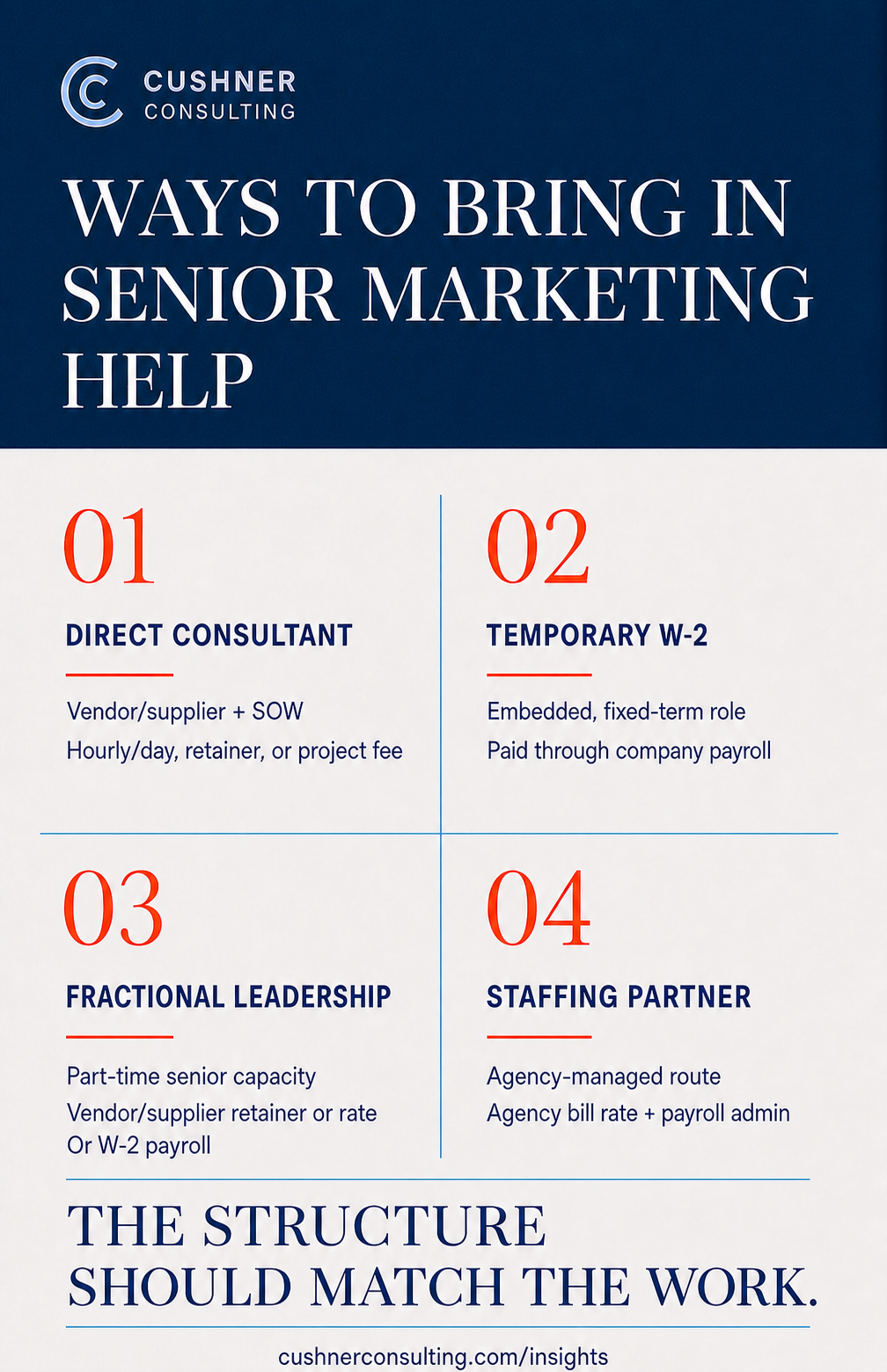
A fractional leader can work through more than one structure. When the relationship supports independent-contractor treatment, the leader may be onboarded as a vendor or supplier and invoice through a monthly retainer, hourly or daily rate, or defined project fee. The leader may instead be a part-time or fixed-term W-2 employee hired directly or supplied through a staffing partner. The payment model does not decide the classification.
The labels answer different questions
Consultant describes the work or role: expertise, diagnosis, problem-solving, or leadership. It does not, by itself, establish how the person is employed or classified.
Freelancer is also a market term, not a separate legal or tax classification. It commonly describes an independent professional who takes on projects for one or more clients, especially in creative, content, media, technology, and other specialist fields. A freelancer may qualify as an independent contractor, but the label alone does not decide that.
A freelancer is not simply a consultant with many clients. In common business use, freelancers often deliver a defined body of work, while consultants are more often brought in to advise, diagnose, solve a business problem, or lead. The work can overlap, one person can do both, and either can have one client or many. None of that decides worker classification.
Companies also use contractor as shorthand for almost any nonpermanent worker, especially when permanent headcount has not been approved. That is common business language, not a classification test. Under federal tax and wage-and-hour rules, independent-contractor status turns on the actual relationship. The relevant tests differ, and state law may add another standard.
Contingent is another term with more than one business use. The Bureau of Labor Statistics uses contingent for a job that is temporary or not expected to last, and separately tracks alternative arrangements such as independent contractors, temporary-help agency workers, and workers supplied by contract firms. Some companies use contingent workforce more broadly, but that usage is not universal.
Contracting out a defined problem or capability is typically structured as an outside service with an agreed scope, deliverables, and statement of work. Staff augmentation typically adds a person to an internal team for a period of time. That is a useful business distinction, but the paperwork does not override the reality of how the work is directed and performed.
The practical lesson is that the title alone never settles the structure. The role and business need can be described in plain English first. HR, legal, procurement, and tax advisors can then determine the appropriate engagement and classification.
- Consultant: describes the expertise, leadership, or problem-solving role, not a worker classification.
- Freelancer: a common market term for independent, often project-based work; not a separate legal classification.
- Contingent worker: formally tied to expected job duration in BLS data, although some companies use the term more broadly.
- Independent contractor: a classification determined from the facts under applicable tax and employment laws, not from the title or contract alone.
- Temporary W-2 employee: an employee hired for a fixed period, either directly or through a staffing agency.
- Staffing partner: a firm that may recruit, employ, supply, and administer a temporary worker; the exact model varies.
When direct consulting makes sense
A direct consulting relationship can be efficient when the business needs senior expertise, a defined outcome, or leadership for a specific period. When the facts support an independent business relationship, the consultant can often be onboarded as a vendor or supplier and work under a master services agreement and statement of work.
A useful statement of work names the business problem, outcomes, timing, reporting relationship, access to stakeholders, fees, and what would trigger additional work. That protects both sides from a vague assignment that quietly expands every week.
Calling someone a contractor in an agreement does not settle worker classification. The IRS looks at the real relationship, including behavioral control, financial control, and the relationship between the parties.
Interim leadership is an operating role
Interim leadership is not advice from the sidelines. The leader steps into a defined operating role for a limited period, leads people and agency partners, sets priorities, and keeps launches, planning, or transformation moving while the permanent structure catches up.
Interim describes the role and its temporary duration. It does not determine the employment structure. Depending on the facts and company policy, an interim leader may be engaged directly as a vendor or supplier under a statement of work, hired as a temporary W-2 employee, or administered through a staffing partner.
Interim leadership is often full-time because the leader is temporarily accountable for the seat. Fractional leadership is part-time senior capacity across a defined remit. Either arrangement can be time-limited, but the practical distinction is accountability: interim leadership temporarily owns the operating role; fractional leadership supplies an agreed share of senior capacity.
- A senior seat is open, but decisions, launches, or team leadership cannot wait.
- The role needs clear accountability, time commitment, priorities, and a plan for the permanent handoff.
- The vendor, temporary W-2, or staffing route can then follow the way the role will actually operate.
Budget and company process shape what is possible
A promising conversation can stall quickly when no one has identified the executive sponsor, budget owner, cost center, estimated fees, or expected business outcome. Funding and the permitted engagement route are not administrative details. They determine whether the work can begin.
People often call a direct engagement a ‘1099 setup.’ More accurately, the consultant is onboarded as a nonemployee vendor or supplier. If the company has determined that independent-contractor treatment is appropriate, it generally collects a Form W-9 and later issues Form 1099-NEC when reporting requirements apply. The tax form reports the relationship; it does not create or define it.
Once onboarding is complete, both sides sign the agreement and statement of work, and the company issues any required purchase order. The consultant may invoice monthly, against milestones, or on another agreed schedule. Referencing the statement of work and purchase order keeps payment from getting stranded between the hiring manager, procurement, and accounts payable.
- Approve the business need, budget, and executive sponsor.
- Confirm whether the company can onboard the consultant directly as a vendor or supplier.
- Complete the required W-9, banking, insurance, security, and vendor-registration steps.
- Sign the master agreement and statement of work.
- Issue the purchase order before work begins when the company requires one.
- Process monthly invoices according to the agreed payment terms.
Hourly, retainer, or project fee?
Consulting compensation does not have to follow one formula. An hourly or daily rate can work well when the need is variable, the assignment is still taking shape, or the company wants to pay for the time used. A monthly retainer can make more sense when the business wants predictable access, an agreed level of capacity, and ongoing leadership across several priorities. A fixed project fee may fit work with a clearly defined deliverable and timeline.
Whichever model is used, the commercial assumptions belong in the statement of work: the hourly or daily rate, the capacity included in a retainer, any overage rate, invoicing schedule, payment terms, approved expenses, and what happens if the scope changes. A retainer buys defined access and responsibility, not unlimited availability.
- Hourly or daily rate: useful for variable demand, working sessions, or an evolving scope.
- Monthly retainer: useful for predictable capacity, ongoing counsel, or interim and fractional leadership.
- Fixed project fee: useful when the deliverable, timeline, and boundaries are clear.
Why this way of working is becoming more common
Marketing organizations are being asked to do something contradictory: deliver growth with fewer layers while redesigning how work gets done with AI. Restructures move roles and redistribute responsibilities, but they do not eliminate launches, decisions, or the need to lead a team. The launch calendar does not care that the org chart is unfinished.
AI is not the sole cause of every workforce reduction, but the forces are converging. Companies are simplifying structures while also deciding which tasks to automate, where human judgment matters, how workflows should change, and which new capabilities the future organization will need.
This is where experienced interim or consulting leadership can be most useful. The value is not simply another pair of hands. It is someone who can step in, decide what matters, steady the team, align internal and agency partners, and keep priority work moving while the permanent structure catches up.
This way of working is likely to become more common, but not because every job will become freelance. The pressure is more practical: skills are changing faster than many companies can redesign roles, build capability, and hire permanent teams. The World Economic Forum's Future of Jobs Report 2025 found that 86% of surveyed employers expect AI and information-processing technologies to transform their business by 2030. It also found that 39% of workers' existing skills are expected to change or become outdated, while 63% of employers already see skills gaps as a major barrier to transformation. In response to AI disruption, 41% of surveyed employers expect to downsize as AI capabilities expand, while 70% plan to hire people with emerging in-demand skills. That is not a simple replacement story. It is a rapid reshuffling of roles, skills, and operating models.
Research from major consulting firms points in the same direction. McKinsey describes future work as a partnership among people, AI agents, and robots, and finds that more than 70% of the skills employers seek today are used in both automatable and non-automatable work. BCG reports that workforce demands can evolve in a matter of months, yet only 36% of respondents in its 2025 AI at Work survey said their employers provided sufficient AI training. Deloitte's 2025 Global Human Capital Trends research found that 85% of surveyed business executives believe organizations need more agile ways of organizing work to adapt quickly.
The goal is not a permanent shadow organization. The best outside leadership stabilizes priority work, transfers knowledge, clarifies what the future team should own, and hands the work back cleanly.
Upwork's 2026 Future Workforce Index offers another signal. Its study of 2,400 U.S.-based skilled knowledge workers found that 38% were freelancing, up from 28% in the prior year's study. Upwork benefits from growth in this category, so the finding is best read as evidence of momentum within its research, not as a neutral forecast for the entire labor market.
The strongest organizations will not treat employees and consultants as an either-or choice. They will build the right mix, using outside expertise to solve a specific problem and move faster while keeping the relationships and capabilities that matter long term inside the business.
Sometimes a temporary W-2 role is the right route
A temporary W-2 arrangement may be more consistent with the relationship when the company controls the schedule and day-to-day work, provides the tools, closely directs how the job is performed, and expects the person to function like an internal employee. The person may be hired directly for a fixed term or employed through a third party.
This model can be clean for an embedded operating role, but it is different from hiring an independent advisor to deliver a defined result. The substance of the relationship matters more than the title on the requisition.
Why a staffing partner may be required
A staffing agency can be useful when a company needs candidates quickly, requires an already approved supplier, or wants a third party to handle payroll, benefits, and employment administration. For some organizations, that convenience is the only practical route through procurement.
Many large companies already have a contingent-workforce program, preferred staffing agency, or managed service provider in place. In that environment, the hiring leader may be required to route the engagement through the approved partner, even when the company and consultant have already found each other. The agency can become the contracting or employment intermediary and manage onboarding, compliance, time reporting, invoicing, and payment.
It is worth clarifying whether the agency is sourcing and screening candidates or simply processing a preselected consultant through an existing program. Those are different services and may carry different fees, terms, and restrictions.
When a staffing agency supplies and pays a temporary worker, OSHA generally treats the agency and host company as joint employers for workplace-safety responsibilities. The responsibilities depend on the facts, and the parties should define and coordinate them rather than assume the agency owns every obligation.
The tradeoff is an added agency margin and a less direct commercial relationship. The value may include sourcing, screening, payroll, benefits, compliance, replacement guarantees, or simply access to the approved program. Conversion fees, contract restrictions, and what happens if the assignment changes are also worth understanding.
An agency is not automatically better or worse. It is worth the premium when the service solves a real problem for the company or the consultant. If it does not, a direct engagement may be simpler.
Six questions that bring the picture into focus
The right route becomes much clearer when the hiring manager, HR, procurement, and legal team are looking at the same facts.
- Is the business buying a defined outcome or filling an operating seat?
- Who will control how, when, and where the work is performed?
- Will the person lead employees, own decisions, or act primarily as an advisor?
- How long will the assignment last, and how much time does it require?
- Can the consultant be onboarded directly as a supplier, or must the company use an approved agency?
- What is the total cost of each route, including fees, administration, and the cost of waiting?
Classification follows the reality of the work
Worker-classification rules are fact-specific, and federal tax, federal employment, and state-law standards can differ. The Department of Labor has also continued to revisit its federal guidance. Companies should involve qualified HR, legal, procurement, and tax advisors rather than relying on a job title, an LLC, a Form 1099, or a template contract.
The goal is not to force the assignment into the cheapest category. It is to use a structure that matches the work, protects both sides, and lets the person contribute quickly.
This article explains common business models and is not legal or tax advice.